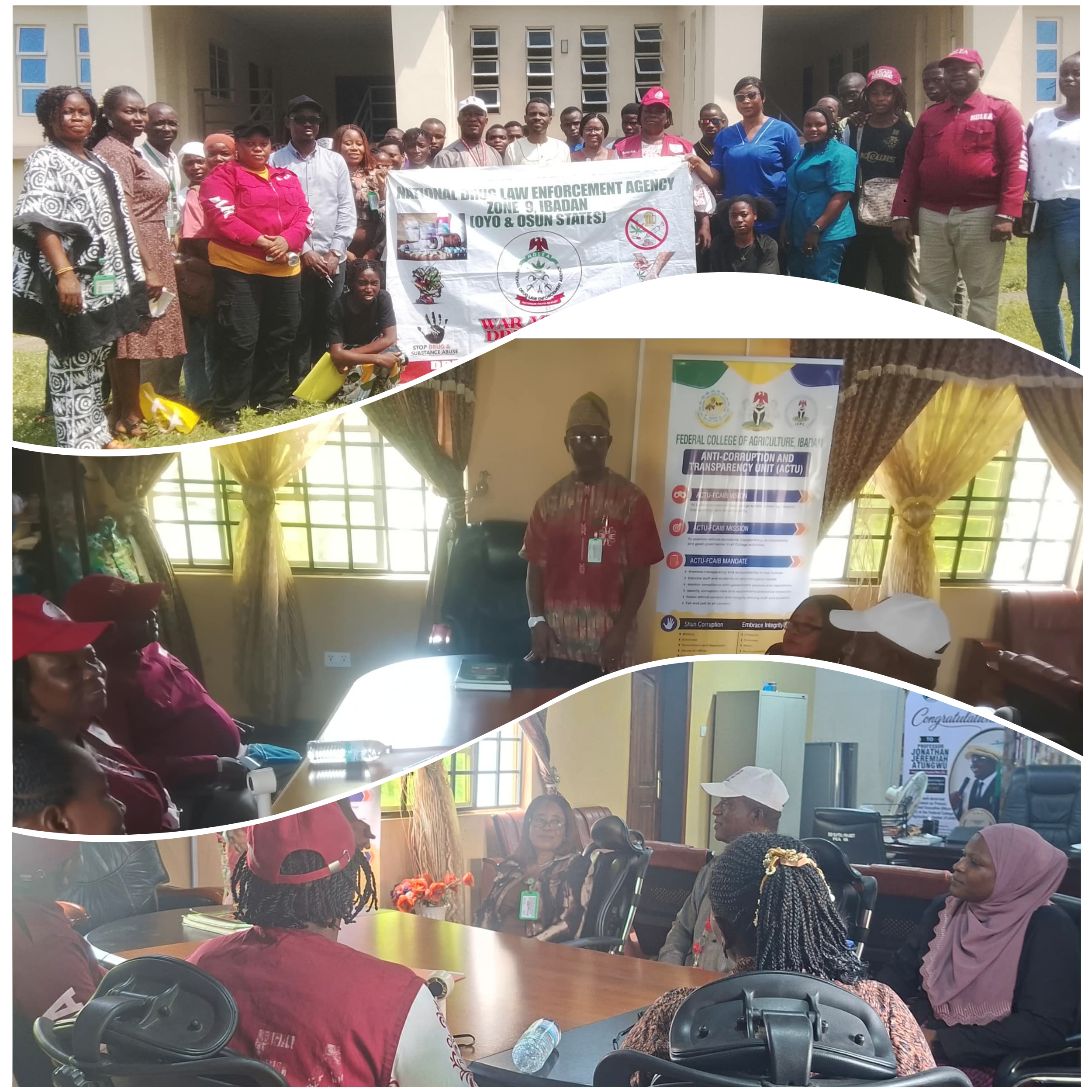
FCAIB HOSTS NDLEA AWARENESS LECTURE ON DRUG ABUSE PREVENTION, URGES STAFF AND STUDENTS TO EMBRACE A DRUG-FREE LIFESTYLE
FCAIB hosts the NDLEA for an awareness lecture on drug abuse prevention, educating staff and students on substance abuse, responsible decision-making, treatment and rehabilitation while promoting a safe, drug-free academic environment.
By Olubisi Olugbade & Sunkanmi Olanrewaju
The Federal College of Agriculture, Moor Plantation, Ibadan (FCAIB), on Wednesday, November 18, 2026, hosted officials of the National Drug Law Enforcement Agency (NDLEA), Oyo State Command, for an awareness lecture on drug abuse prevention, aimed at educating staff and students on the dangers of substance abuse and promoting responsible decision-making.
The programme featured a presentation titled “Drug Abuse Among Nigerian Students and Youth: A Growing Concern,” delivered by Mr. Ogungbemiro George Tosin, Assistant Superintendent of Narcotics (ASN I), Drug Demand Reduction Unit, NDLEA, Ibadan Zonal Command.
The Provost of the College, Professor Jonathan Jeremiah Atungwu, was represented at the event by Dr. Okpeze Victoria E., Deputy Provost Academics; who attended alongside other members of the College Management Team, staff and students.
Also present was Barrister Elum Samuel, who represented the Chairman of the Anti-Corruption and Transparency Unit (ACTU), Engr. Ayoade Atere. In his contribution, he educated participants on the legal implications and consequences of criminal conviction, drawing attention to the long-term effects of criminal records on an individual's reputation, career opportunities and future prospects. His remarks reinforced the importance of personal discipline, lawful conduct and responsible choices.
The Dean, School of Applied Sciences, Dr. Olufemi Adedire, also made valuable contributions to the discussion. He advocated a constructive and rehabilitative approach towards addressing drug-related challenges, suggesting that individuals involved in illicit drug cultivation should be encouraged to embrace vocational training and alternative livelihood opportunities. He further recommended stronger collaboration between the College and the NDLEA to facilitate skills acquisition and rehabilitation initiatives.
Dr. Adedire also proposed that students should undergo appropriate drug screening exercises as part of efforts to promote a drug-free academic environment. He equally called for the regular organisation of such awareness lectures to ensure sustained education, sensitisation and preventive engagement within the College community.
During the presentation, the NDLEA resource person examined the prevalence of drug abuse in Nigeria, the classification of drugs, factors responsible for substance use, and the progression from drug use to harmful use and dependence. He also highlighted the physical, psychological, academic, social and financial consequences of substance abuse.
The lecture further addressed common myths surrounding drug and alcohol use, while emphasising informed decision-making, personal discipline, resistance to negative peer pressure and healthy stress-management practices.
An interactive question-and-answer session followed the presentation, providing participants with the opportunity to seek clarification on critical issues surrounding drug abuse, prevention, treatment and rehabilitation.
Responding to a question on the measures being adopted by the Agency to address drug dependence, the NDLEA delegation explained that, in line with the new policy direction of the President, individuals experiencing drug dependence should be approached as persons requiring medical attention, treatment and rehabilitation rather than being automatically treated as criminals.
Another question centred on how students could contribute to the fight against drug abuse in their communities without exposing themselves to danger. The Agency encouraged students to adopt safe and responsible approaches, including awareness creation, peer education and reporting suspicious activities through appropriate channels rather than confronting suspected offenders.
The Zonal Commander, Zone 9, Ibadan, CN Yahaya Rasheed Bola, also addressed concerns about the use of prescribed medications. He explained that medications duly prescribed by qualified medical doctors and pharmacists, with appropriate medical justification, should not be regarded as illegal merely because they are controlled substances. He, however, stressed that misuse, excessive dosage and abuse remain serious concerns that must be addressed through responsible medication practices.
The Acting Head of the College Health Centre, Nurse Christiana Anetor, raised an important question on the challenges of drug dependence and relapse. She sought clarification on the appropriate intervention for an individual who, despite undergoing treatment on three different occasions, continues to return to drug use.
In response, CN Yahaya Rasheed Bola recommended sustained counselling, proper monitoring and follow-up as essential measures for supporting individuals experiencing repeated relapse. He emphasised the need for continuous professional guidance and supervision to improve the chances of recovery.
Similarly, AZCN Sanni Oluranti stressed that individuals struggling with drug dependence should be regarded primarily as persons requiring medical attention and rehabilitation rather than being labelled criminals simply because of their condition. She further recommended referral to appropriate rehabilitation centres where they could receive professional care, treatment and support towards recovery.
Participants were equally enlightened on recognising the warning signs of substance use disorders and the importance of replacing stigmatisation with understanding, encouragement and appropriate professional support for individuals experiencing drug-related challenges.
Following the successful conclusion of the programme, the Provost of the College, Professor Jonathan Jeremiah Atungwu, received and hosted the NDLEA delegation in his office. The reception provided an additional opportunity for interaction and discussions on strengthening institutional collaboration in drug abuse prevention, rehabilitation, awareness creation and the promotion of a safe and healthy academic environment.
The programme underscored the importance of sustained collaboration between educational institutions, relevant government agencies and other stakeholders in tackling drug abuse, safeguarding young people and creating a safe, healthy and productive learning environment.
The engagement further demonstrated FCAIB's commitment to the welfare, discipline, personal development and academic success of its staff and students through continuous awareness, education and strategic institutional partnerships.
The Fcaib. The First, The Best!
Related Articles
More news in General
FCAIB, IAR&T, NACGRAB AND FCAH&PT COLLABORATE TO MARK NIGERIAN LIBRARY ASSOCIATION WEEK 2026
FCAIB and three sister institutions collaborate to mark NLA Week 2026 with a professional workshop on ORCID adoption, promoting research visibility, institutional cooperation and professional development.
Read MoreFCAIB HOSTS LOC AHEAD OF 19TH ANNUAL ORGANIC AGRICULTURE CONFERENCE IN ABEOKUTA
FCAIB hosted the LOC of the 19th Annual Organic Agriculture Conference ahead of the November 15–19 event at FUNAAB, Abeokuta. The visit highlighted institutional collaboration in promoting organic agriculture and sustainable farming in Nigeria.
Read MoreFCAIB CONCLUDES 3-DAY EXECUTIVE TRAINING ON PUBLIC PROCUREMENT MANAGEMENT WITH IPESS
FCAIB has concluded a three-day Executive Training on Public Procurement Management in collaboration with IPESS, equipping participants with skills to enhance transparency, efficiency, compliance and value for money in public procurement.
Read More