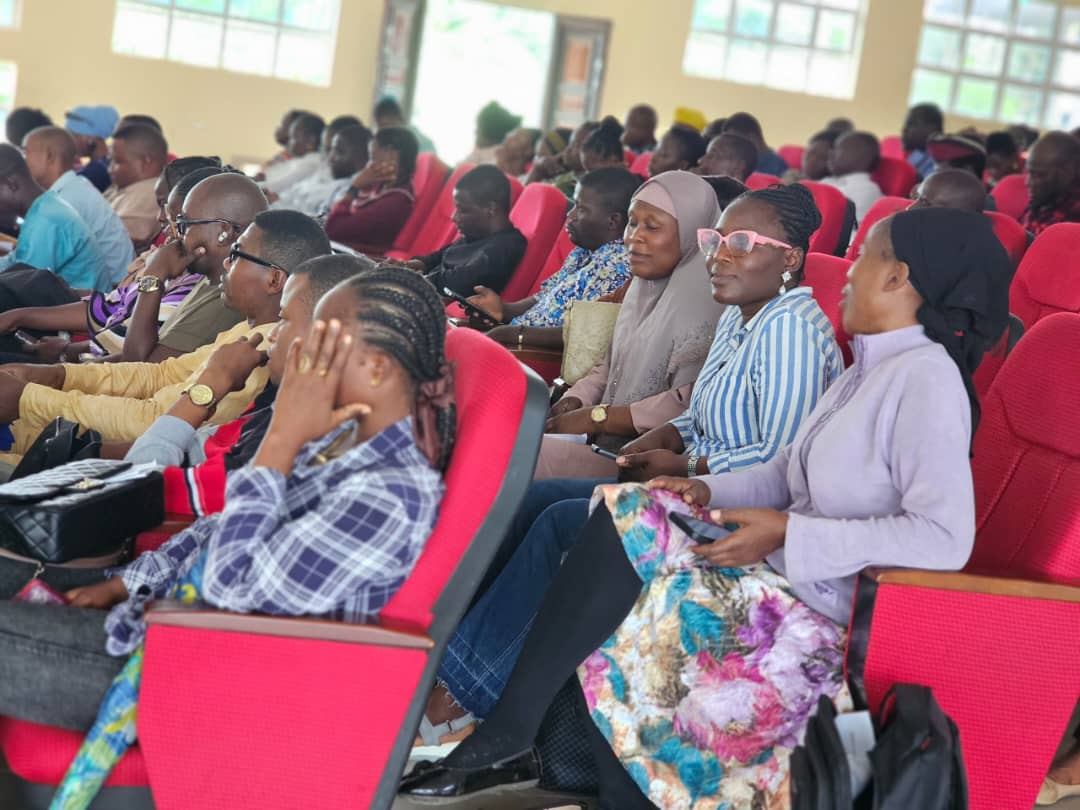
FCAIB Holds Examination Ethics Seminar to Strengthen Academic Integrity
To strengthen the credibility of its assessment system, FCAIB convened staff for an Examination Ethics Seminar, where facilitators emphasised integrity, accountability and the shared responsibility of upholding fair and transparent examinations.
By Oyekemi Wilson
As part of efforts to uphold academic excellence and preserve the integrity of its examination system, the Federal College of Agriculture, Moor Plantation, Ibadan (FCAIB), has organised a comprehensive Examination Ethics Seminar for staff, reinforcing best practices in examination administration and the shared responsibility of maintaining credible assessment processes.
The seminar commenced with the opening remarks from the Chairman of the Timetable Committee, Mr. Olaoye.
Declaring the seminar open, the Provost, Prof. Jonathan J. Atungwu, highlighted the importance of examination ethics in sustaining the College's academic standards and explained the need for continuous sensitization of both staff and students on examination integrity.
The seminar was facilitated by Dr. Olusegun Anthony Omoyajowo and Engr. Dr. Ayoade Atere, who delivered insightful presentations on the theme, _"Examination Ethics: Roles and Responsibilities of Staff and Students."_ They described examination ethics as the moral principles, institutional regulations and professional standards that promote honesty, fairness, confidentiality, accountability and transparency in teaching, learning and assessment. According to the facilitators, maintaining examination integrity is a collective responsibility involving students, lecturers, invigilators and the institution as a whole.
They both identified common forms of examination malpractice among students to include copying, impersonation, collusion, the use of technological devices, bringing unauthorised materials into examination halls and illegally obtaining examination questions.
They also highlighted unethical practices that could be perpetrated by staff, including leakage of examination questions, alteration of scores, favouritism, negligence during examination invigilating and sexual harassment in exchange for academic marks.
The facilitators attributed the growing incidence of examination malpractice to factors such as overcrowded examination halls, poor planning, weak enforcement of regulations, inadequate facilities, certificate syndrome, materialism and the celebration of wealth without integrity. Participants were taken through the responsibilities of examination officials before, during and after examinations.
These include setting standard questions that adequately cover the approved syllabus, ensuring strict confidentiality of examination materials, arriving early at examination venues, verifying students' identities, maintaining active supervision throughout examinations, objectively marking scripts, promptly releasing results and maintaining professionalism at every stage of the examination process.
The seminar further emphasised the core values expected of all staff, including integrity, justice, transparency, accountability and professionalism, while highlighting the consequences of compromising examination ethics.
Students found guilty of examination malpractice, the facilitators noted, may face penalties ranging from cancellation of results and suspension to outright expulsion, loss of certificate credibility and damage to their future careers.
Likewise, staff involved in examination misconduct risk disciplinary actions, including queries, withdrawal of examination duties, dismissal, prosecution and actions capable of affecting the institution's accreditation and public confidence. To further promote examination integrity, participants were encouraged to sustain ethics orientation programmes for staff and students, strengthen examination invigilating, ensure adequate seating arrangements, secure the setting, printing and storage of examination questions, provide counselling for students experiencing academic pressure and maintain transparency in the release of examination results.
The seminar also reviewed the College's examination rules and regulations for students, stressing the prohibition of mobile phones, smart watches connected to phones and unauthorised materials in examination halls. Students were reminded to report at examination venues at least thirty minutes before commencement with valid College identity cards and examination clearance, while observing all examination regulations.
Similarly, examination officials were reminded to arrive early, dress professionally, treat all candidates fairly, remain vigilant throughout the examination, maintain confidentiality and promptly report every form of examination irregularity.
During the interactive session, participants recommended the provision of functional wall clocks in examination venues following the prohibition of mobile phones, the inclusion of duly registered carry-over students on attendance sheets and the harmonization of examination regulations to eliminate possible conflicts in implementation.
The recommendations were adopted following a motion moved by Mr. Mikaheel and seconded by Mrs. Olanrewaju Kudirat Okanlawon. Mrs. Amanda delivered the vote of thanks, appreciating the College Management, facilitators and participants for their commitment to promoting a culture of integrity, accountability and excellence in the College's examination processes.
The seminar concluded with Chairman of the Timetable Committee, Mr. Olaoye, formally bringing the programme to a successful close.
This seminar marks another ethics and integrity milestone in the history of the first College of Agriculture in Nigeria.
FCAIB, the First, the Best!
Related Articles
More news in Academics
FCAIB HOLDS ORIENTATION PROGRAMME FOR NEWLY EMPLOYED STAFF
FCAIB has held an orientation programme for newly employed staff, with Management and senior officials providing guidance on the College’s policies, work ethics, administrative procedures and professional responsibilities.
Read MoreFCAIB COMMENCES 2026 FINAL-YEAR STUDENTS’ PROJECT DEFENCE
FCAIB has commenced the 2026 Final-Year Students’ Project Defence, with students presenting and defending their research projects before a panel of lecturers and industry experts.
Read MoreFCAIB STRENGTHENS ACADEMIC TIES WITH LASUSTECH AS ANIMAL SCIENCE DELEGATION VISITS PROVOST
FCAIB Hosts LASUSTECH Academics on Congratulatory Visit FCAIB welcomed senior academics from LASUSTECH’s Department of Animal Science, led by Professor Agbaje Folorunsho, to congratulate Provost Professor Jonathan J. Atungwu and explore opportunities for stronger institutional collaboration.
Read More